
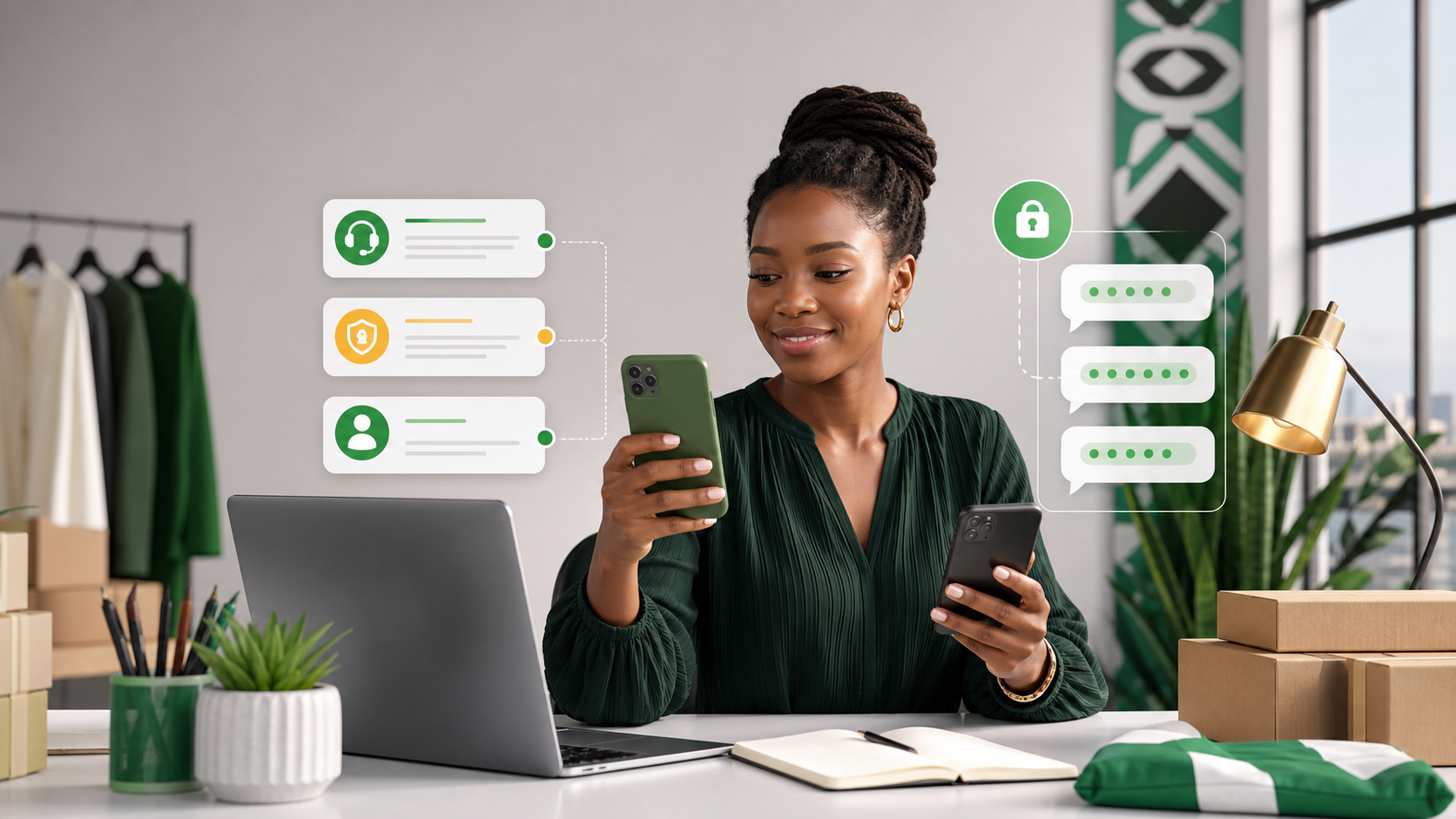
Nigerian online sellers often use one SIM for support, WhatsApp, OTPs, and personal calls. Learn why separating customer support and verification numbers improves privacy and control.
Many Nigerian online sellers start with one phone number for everything. The same SIM handles customer calls, WhatsApp messages, delivery updates, payment confirmations, personal chats, and every OTP code needed to create online accounts.
That setup is simple at the beginning, but it can become messy as the business grows. A number that customers know should not always be the same number used for private verification, account recovery, platform testing, or new business tool setup.
Separating customer support numbers from OTP verification numbers gives sellers more control over privacy, account access, and daily operations.
Why One Number Becomes a Problem
A single SIM can work when you are testing a business idea. But once orders, ads, staff, delivery partners, vendors, and customers enter the picture, that number carries too much responsibility.
Using one number for everything can create practical issues:
Customers may keep calling a number you also need for private account recovery.
Staff or assistants may need access to business messages but should not see personal OTPs.
Old customers may still have the number long after you stop using it for support.
Spam, promotional texts, and customer messages can mix with important security codes.
If the SIM is lost or unavailable, both customer support and account access are affected at once.
The goal is not to make phone management complicated. The goal is to avoid letting one phone number become a single point of failure.
Customer Support Numbers Have a Public Role
A support number is meant to be shared. Sellers place it on WhatsApp Business, Instagram, TikTok, flyers, order forms, delivery notes, marketplace profiles, and customer receipts.
Because customers and prospects need to reach you, that number naturally becomes public. It may be saved by buyers, forwarded in group chats, used by delivery agents, and posted on business pages.
That public role is useful for sales and trust, but it makes the number a poor choice for every private verification task. The more widely a number is shared, the less private it becomes.
OTP Verification Numbers Have a Private Role
An OTP verification number is different. It is used to receive codes when signing up for services, testing tools, confirming access, or completing security checks.
For Nigerian sellers, OTP codes may be needed for:
WhatsApp Business and backup tools
Email and cloud storage accounts
Social media management platforms
Payment, shipping, and marketplace dashboards
CRM, invoicing, support, and advertising tools
Developer or automation tools used by the business
Some of these tools are temporary. Some are only used during setup. Others belong to staff workflows, side projects, or experiments. Your main support line should not automatically be attached to all of them.
Where Virtual Numbers Help
A virtual number lets you receive SMS verification codes online without exposing your main SIM for every signup. With a service like BillioPlus, a seller can choose a supported service, use an available virtual number, and receive the verification code through an online dashboard.
This is useful when you need to verify supported platforms, test account flows, set up tools, or avoid placing your personal SIM into every form on the internet.
Virtual numbers can help sellers:
Keep their personal SIM more private.
Reduce clutter between support messages and security codes.
Set up supported tools faster.
Test business workflows without buying multiple physical SIMs.
Separate customer-facing communication from internal setup tasks.
A Simple Number Separation Plan
You do not need a complex telecom system to start separating phone usage. A basic structure is enough for many sellers.
Use one number for customers
This is the number you place on your public profiles, WhatsApp Business page, order forms, and delivery instructions. It should be easy for buyers to recognize and contact.
Use another number for private or temporary verification
When you are signing up for supported tools, testing a platform, or receiving a one-time code, avoid using the same number you publish everywhere. A virtual number can be a practical option for these moments.
Keep recovery numbers intentional
For accounts you will depend on for years, choose carefully. Some platforms may ask for the same number again during recovery. Do not use a temporary verification option for banking, government identity, legal, tax, or any permanent account where long-term recovery matters.
Limit staff access
If assistants help with customer support, give them access only to the channels they need. They do not need to see private OTPs for unrelated tools.
When Sellers Should Be Extra Careful
Number separation is especially important when the business starts growing beyond one person.
Be more intentional if:
You run ads and receive many new customer messages.
You use assistants to answer WhatsApp or Instagram DMs.
You test many online tools for sales, delivery, design, or accounting.
You manage multiple business pages or marketplaces.
Your personal SIM is also tied to family, banking, or private accounts.
The more roles a number has, the more damage a simple mistake can cause. Separating roles early keeps the business easier to manage.
How BillioPlus Fits In
BillioPlus helps Nigerians receive OTP codes online using virtual numbers for supported services.
Instead of exposing your main SIM during every signup, you can use BillioPlus to receive SMS verification codes online when a supported platform requires phone verification.
For online sellers, this makes it easier to protect personal privacy, test tools, and keep customer support communication separate from internal verification work.
Conclusion
Your customer support number and your OTP verification number do not have to be the same. One is public and customer-facing. The other is often private, temporary, or tied to account setup.
For Nigerian sellers, separating those roles can reduce confusion, protect privacy, and make business operations cleaner as the store grows.
If you need a practical way to receive OTP codes online for supported services, start with BillioPlus.
Tags
Chinedu Celestine Okpala
BillioPlus Team · Content & Guides